
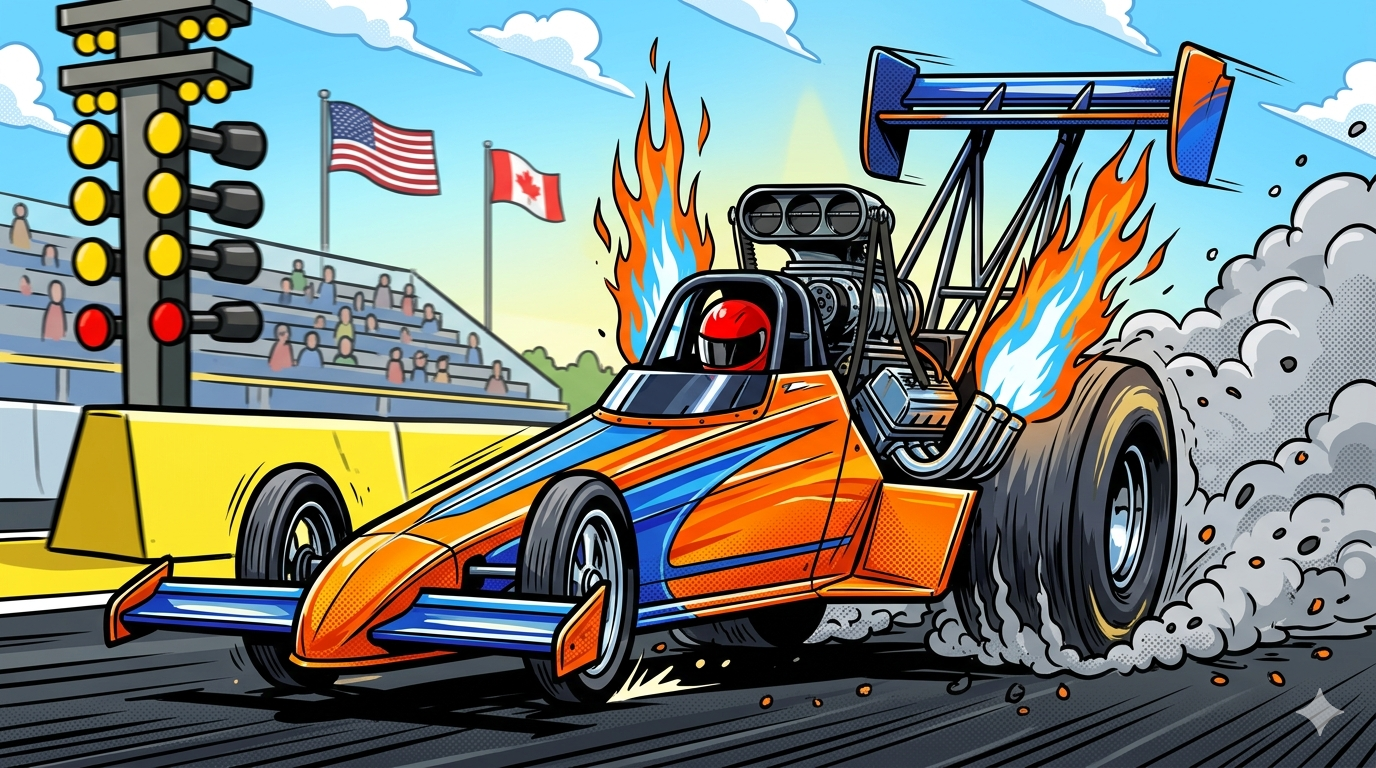
A NASCAR race lasts 500 miles. An NHRA Top Fuel race lasts approximately 3.6 seconds.
If you blink, you will miss the entire event. But in that handful of seconds, a nitro dragster does things to physics that shouldn’t be possible. If F1 is a surgeon’s scalpel, Top Fuel is a 12,000-horsepower sledgehammer with a rocket strapped to it.
When we talk about the most extreme motorsports on earth, this is it. Here is the lowdown on the violent, explosive science that happens every time a Top Fuel pilot hits the ‘Christmas Tree.’
12,000 Horsepower and the 8,000 RPM Burn
Let’s break down that number, because it’s hard to process.
A high-performance street car might have 500 horsepower. A semi-truck has maybe 600. An F-16 fighter jet engine generates roughly 29,000 pounds of thrust, which is equivalent to… a whole lot of horsepower.
A Top Fuel dragster does not use a transmission. The massive rear tires are direct-drive, connected straight to the supercharged, 500-cubic-inch Hemi engine. When the light turns green and the clutch seals, all 12,000 horsepower hits the track at once.
The engine doesn’t just ‘run’; it is essentially a controlled explosion. The fuel pump delivers 100 gallons per minute of nitromethane—the same explosive mixture used in professional demolition—directly into the cylinders at over 8,000 RPM. This fuel is so volatile that the engine is built to run for less than three minutes total, including the warmup and burnout, before it needs to be completely rebuilt.
The Science of ‘Hooking Up’
It’s not about how fast the engine spins; it’s about how that energy translates to motion. A Top Fuel car will hit 100 MPH in less than 0.8 seconds. This requires a level of traction that standard tires cannot come close to providing.
This is why Top Fuel tires (the ‘slicks’) are so massive, and why they wrinkle during launch. The tire is designed to flex and stretch, essentially becoming an extendable paddle that claws at the specially treated ‘sticky’ tarmac track surface. The goal isn’t ‘spinning’ the tires; it is getting the soft rubber to fuse with the track at molecular levels. If the tires lose traction (called ‘smoking the tires’), the engine can instantly over-rev and violently explode. It is a terrifying high-wire act.
Physics vs. the Driver
The experience in the cockpit is brutal. A driver launching a Top Fuel dragster pulls 4 to 5 Gs—more than a fighter pilot or a space shuttle launch. The acceleration is so intense that the driver’s vision may momentarily blur, and they must hold their breath because the force makes it impossible to inhale.
But the real threat isn’t just G-force; it’s the vertical force. The dragster is designed to lift the front wheels off the ground to transfer all weight to the rear tires. The driver is fighting to keep a 300-MPH, nitro-burning beast in a straight line, while essentially riding a vertical wheelie.